On this page
Headphones are the most personal piece of audio gear you can own — and often the best value. A few hundred dollars buys sound quality that would cost thousands in speakers. But “headphones” covers a huge range of designs, and choosing the wrong type is the most common mistake.
By fit: how headphones sit on your head
Circumaural
Ear cups surround your whole ear. Usually the most comfortable for long sessions and the best for bass and soundstage.
Supra-aural
Pads rest on your ears. Smaller and lighter than over-ears, but can press on the ear and leak more sound.
IEMs
Sealed into the ear canal with silicone or foam tips. Excellent isolation and detail; fit is crucial.
Open earbuds
Rest in the outer ear without sealing (like classic wired earbuds). Comfortable and aware of surroundings, but weak bass.
Bone conduction & air
Sit outside or just in front of the ear so you hear traffic and people. Popular for running and cycling.
Open-back vs closed-back
This is the most important distinction for over-ear headphones, and it changes how they sound and where you can use them.
| Open-back | Closed-back | |
|---|---|---|
| Design | Grille on the outside of the cups lets air and sound pass through | Solid cups seal the sound in |
| Sound | Spacious, natural, “speaker-like” soundstage | More intimate, often stronger bass punch |
| Isolation | Almost none — you hear the room, the room hears you | Good — blocks some outside noise and leaks little |
| Best for | Quiet home listening, mixing, critical listening | Commuting, offices, recording, shared spaces |
| Avoid if | You listen near others or in noisy places | You get hot ears easily or want maximum spaciousness |
There are also semi-open designs that sit in between, offering some spaciousness with a little less leakage.
Wired vs wireless
Wired headphones
Wired headphones receive an analogue signal from a DAC and amplifier in your phone, computer or a dedicated headphone amp. They don’t need charging, have zero latency, and at any given price usually offer better sound quality, because none of the budget goes into batteries, radios and chips.
Pros
- Best sound per dollar
- No battery to wear out — can last decades
- No latency for gaming or music production
- Replaceable cables on many models
Cons
- Many phones no longer have a headphone jack
- Cable can snag or tangle
- Demanding models may need an amp
Bluetooth headphones
Bluetooth headphones contain their own DAC, amplifier and battery. The audio is compressed with a codec before being sent over the air. Modern codecs are good enough that most listeners on the move won’t notice a problem — and features like active noise cancelling make them ideal for travel.
Pros
- Freedom of movement, no cable
- Often include ANC, transparency mode, microphones
- App EQ and personalisation
Cons
- Batteries degrade after a few years
- Lossy compression on most codecs
- Some latency — noticeable in games and video on some devices
Bluetooth codecs at a glance
| Codec | Where you’ll find it | Notes |
|---|---|---|
| SBC | Every Bluetooth audio device | The mandatory baseline. Fine at good bitrates, variable in practice. |
| AAC | Apple devices, most headphones | Works very well with iPhones; performance on Android varies. |
| aptX / aptX HD / aptX Adaptive | Many Android phones with Qualcomm chips | Lower latency (Adaptive) and higher bitrates (HD). Both ends must support it. |
| LDAC | Sony and many Android devices | Up to ~990 kbps in ideal conditions; often drops lower to keep a stable link. |
| LC3 (LE Audio) | Newer phones and headphones | The newer Bluetooth standard: efficient, low-power, enables Auracast broadcast audio. |
A codec only works if both your phone and headphones support it. Check your device’s developer or Bluetooth settings to see which codec is actually in use.
True wireless earbuds
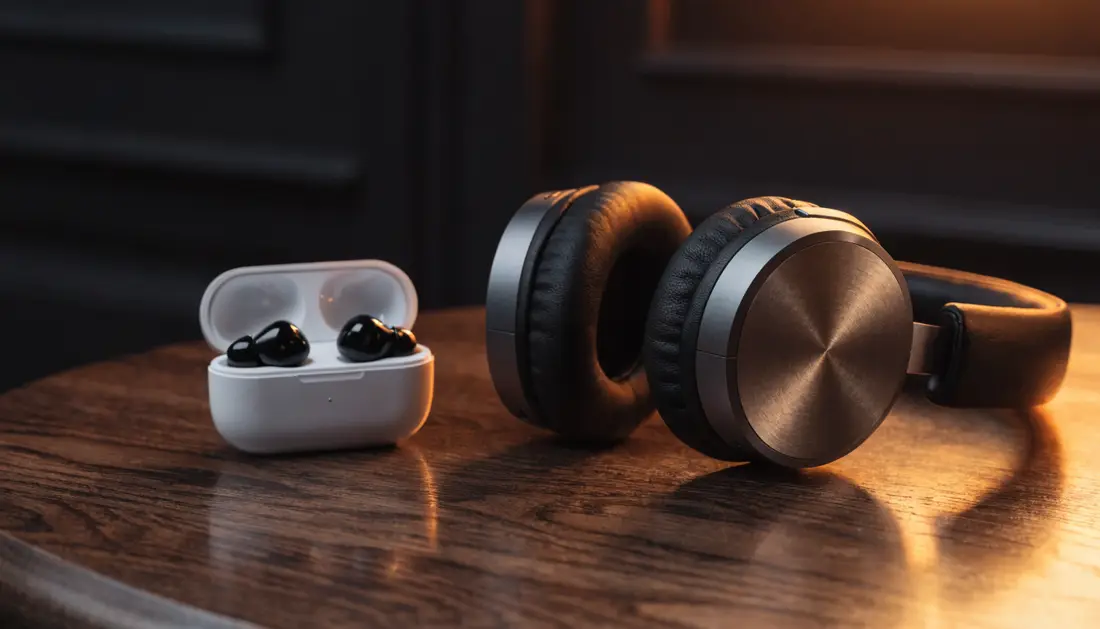
True wireless stereo (TWS) earbuds have no cable at all — each bud is its own small device, charged in a pocket-sized case. They’re now the best-selling headphone category in the world. Look for a secure, comfortable fit (try the different tip sizes), a reliable connection, decent battery life and, if you travel or commute, effective noise cancelling.
In-ear monitors (IEMs)
IEMs grew out of the monitors musicians wear on stage. They seal deep in the ear canal, giving strong isolation and remarkable detail for their size. Hobbyist IEMs are usually wired with detachable cables and come in huge variety — from inexpensive single-driver models to multi-driver designs.
The ear tips matter enormously. A poor seal loses bass and changes the whole tonal balance. Try every size in the box, and consider foam tips if silicone won’t stay put.
Noise cancelling (ANC)
Passive isolation is simply the physical seal of the ear cups or tips. Active noise cancelling uses microphones to measure outside noise and plays an inverted signal to cancel it. ANC is excellent at removing steady low-frequency noise such as aircraft engines, trains and air conditioning; it is less effective against sudden or high-pitched sounds like voices and clatter.
Most ANC headphones also have a transparency / ambient mode that pipes outside sound in, so you can hear announcements or talk without removing them.
Driver types
Dynamic
A cone-shaped diaphragm moved by a voice coil and magnet. Versatile, affordable, great bass.
Balanced armature
Tiny, precise drivers often used in groups, each handling part of the frequency range.
Planar magnetic
A thin film with embedded conductors between magnets. Low distortion and tight bass; often heavier and harder to drive.
Electrostatic
An ultra-thin charged membrane. Exceptionally detailed; requires a dedicated energiser/amplifier.
Many modern IEMs are hybrids that combine a dynamic driver for bass with balanced armatures for mids and treble.
Do you need a headphone amp or DAC?
Most headphones, especially Bluetooth models and IEMs, don’t. Two specs tell you whether a wired pair might benefit:
- Impedance (Ω): higher-impedance models (e.g. 250–600 Ω) need more voltage to reach good volume.
- Sensitivity (dB/mW or dB/V): lower sensitivity means more power is needed. Many planar magnetic headphones fall in this group.
If your headphones sound quiet or thin at maximum phone volume, a small USB DAC/amp dongle or desktop headphone amp will help. See our DACs & streaming guide and specs explained.
Which headphones should you buy?
| You want… | Choose |
|---|---|
| Music on the commute, calls, travel | True wireless earbuds or over-ear Bluetooth with ANC |
| Best sound at home in a quiet room | Open-back wired over-ears |
| Home listening with family nearby | Closed-back wired or wireless over-ears |
| Sports and running | Secure-fit sports earbuds, or open-ear/bone conduction for awareness |
| Gaming | Open-back for spatial cues, or closed-back headset with mic; wired or low-latency wireless |
| Recording and music production | Closed-back studio headphones for tracking; open-back for mixing |
| Maximum detail in a small package | Wired IEMs |
Care and hearing safety
- Keep volume moderate. Many phones include a hearing-health feature that tracks exposure — turn it on.
- Noise cancelling helps: you won’t need to turn music up to drown out noise.
- Clean ear tips and pads regularly; replace worn pads — they change the sound.
- Store wireless models partially charged if you won’t use them for months.
Frequently asked questions
Are open-back headphones better than closed-back?
Not better, just different. Open-backs usually sound more spacious and natural but leak sound and don’t isolate. Closed-backs are more practical in shared or noisy places.
Do wired headphones sound better than Bluetooth?
At the same price, wired headphones usually offer better sound quality because the whole budget goes into acoustics. The gap has narrowed a lot, and for many people wireless convenience is worth it.
What is the difference between IEMs and earbuds?
IEMs seal inside the ear canal for isolation and bass. Classic earbuds sit loosely in the outer ear without a seal. “Earbuds” is also used loosely for any small in-ear headphone, including true wireless models.
How long do wireless earbuds last?
Typically two to four years of regular use before battery capacity drops noticeably. Wired headphones can last much longer, especially with replaceable cables and pads.